
Tunable: the tuner app for every instrument
Tunable is a chromatic tuner app for iPhone, iPad, Mac and Android. It is a one-time purchase, $7.99 on the App Store and $6.99 on Google Play, with no subscription and no ads. It is rated 4.8 stars from more than 9,500 ratings and is used by students at Juilliard and Berklee, by Broadway pit musicians, and by more than a million players who tune with it before they practice.






| Price | $7.99 iOS and Mac, $6.99 Android. One purchase, no subscription, no ads. |
| Platforms | iPhone and iPad (iOS 13+), Mac (macOS 11+), Apple Vision, Android phones and tablets |
| Rating | 4.8 out of 5, 9,500+ ratings across both stores |
| Tuner | Chromatic, any instrument, pitch history line, skill-level in-tune zone, cents and Hz display |
| Reference pitch | Concert A adjustable from 415 Hz to 466 Hz |
| Temperaments | 15+ built in (equal, just, Pythagorean, meantone, Werckmeister, Kirnberger and others) plus custom |
| Transposition | Presets for Bb, Eb, F, A and other transposing instruments, 15 notation systems |
| Also in the app | Metronome with subdivisions and Ableton Link sync, tone and chord generator, session recording with Practice Score, ear training |
What a good tuner app does that a needle does not
Every tuner app shows a note name and a needle. That answers one question, "am I in tune right now?", and for a guitarist turning a peg it is enough. For anyone who shapes a note while it sounds, a wind player, a string player, a singer, the more useful question is "what did my pitch do over the whole note?" Tunable answers that one.
See your intonation, not just a needle
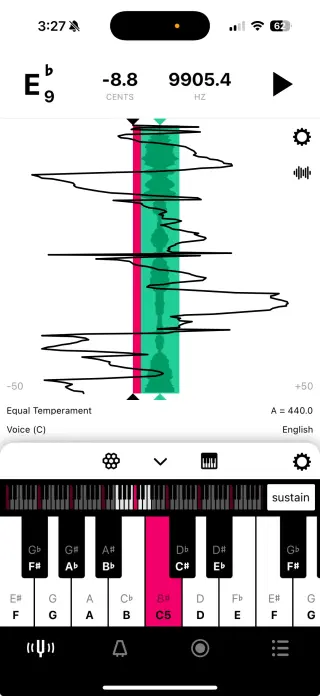
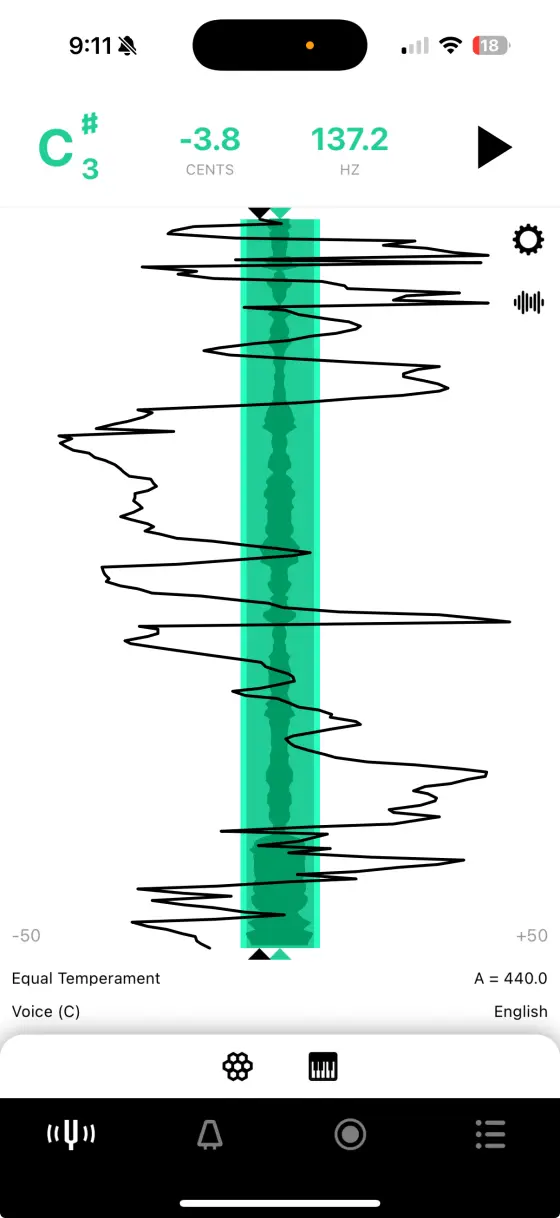
A line traces where your pitch has been for the last several seconds. A steady horizontal line is a well-supported note; a slope is a note going flat as the breath runs out; a wave is vibrato, and you can see its width and speed. The free online tuner shows the same line so you can see what it looks like before buying.
The green in-tune zone is adjustable by skill level. Beginners get a wide target that rewards getting close; advanced players narrow it to a few cents.
Get a score for every session
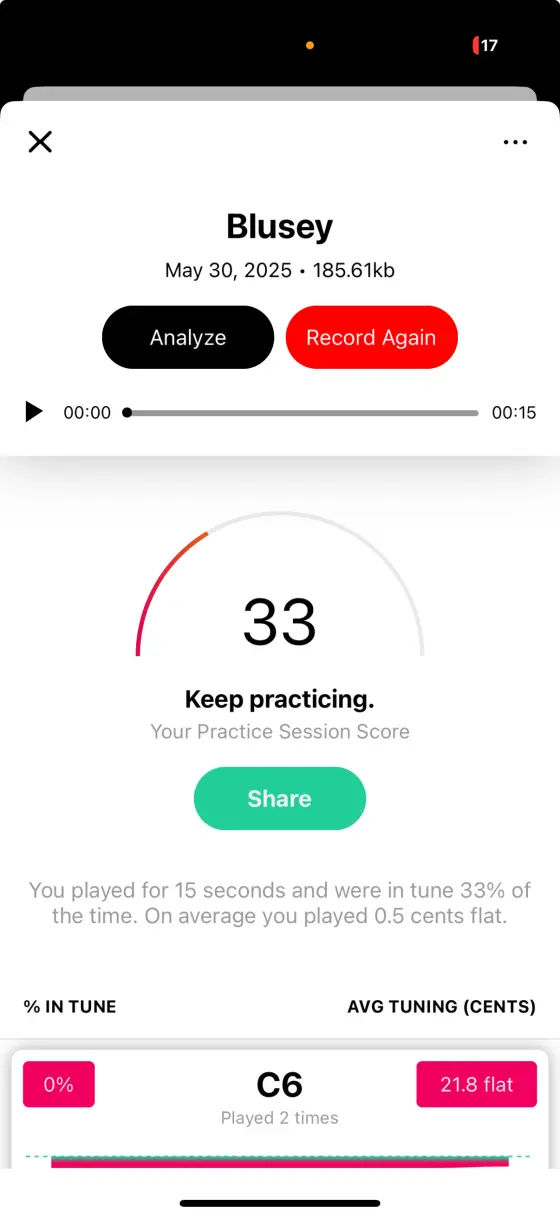
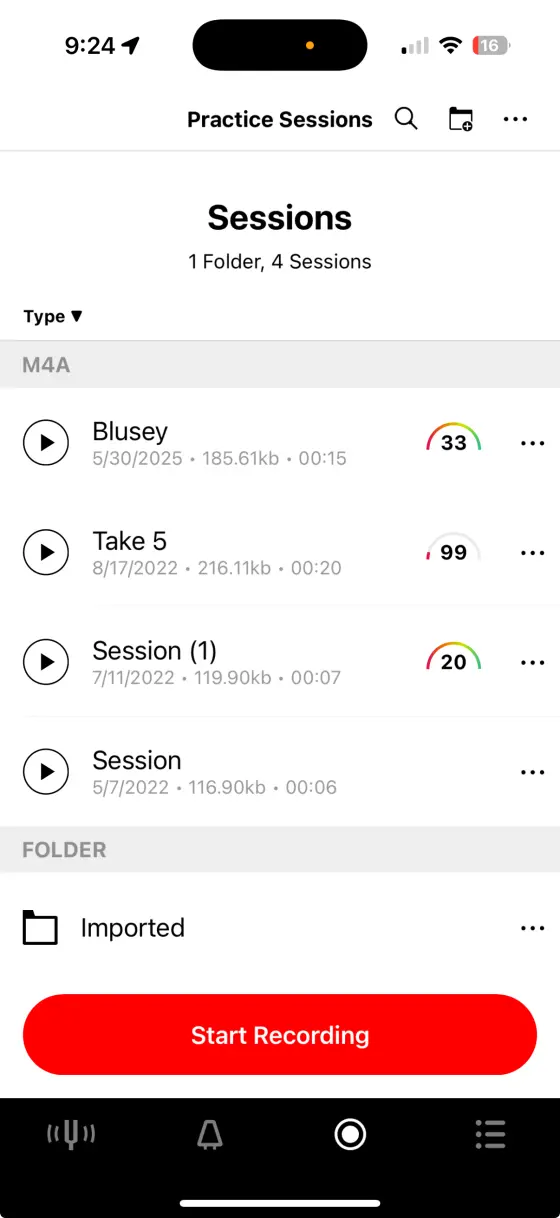
Practice Score measures how much of each note you held inside the in-tune zone and turns it into a score per session, so a week of long tones becomes a number that goes up. Recordings keep a note-by-note graph you can send to a teacher.
Hear the pitch before you play it
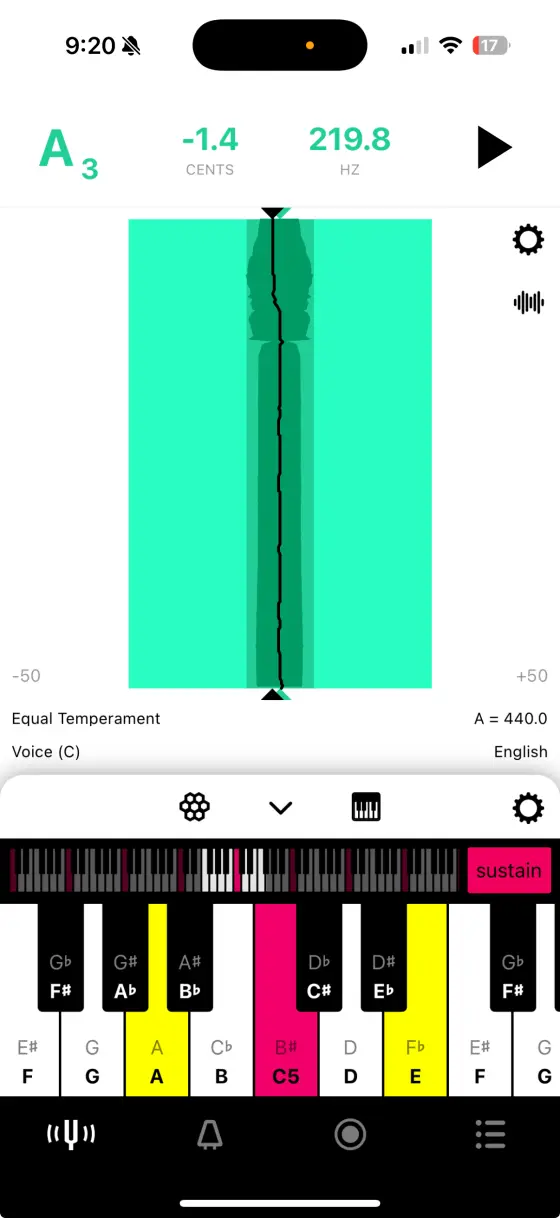
The tone and chord generator sustains a single note or a full chord in any of the app's temperaments. Tune into it, sing against it, or give a section its A at 440, 441 or 442.
Equal temperament is what a piano uses, and what most tuner apps assume. Choirs, string quartets, brass sections and early-music players tune chords in just intonation or a historical temperament. Tunable ships 15+ and lets you define your own in cents.
Keep time together
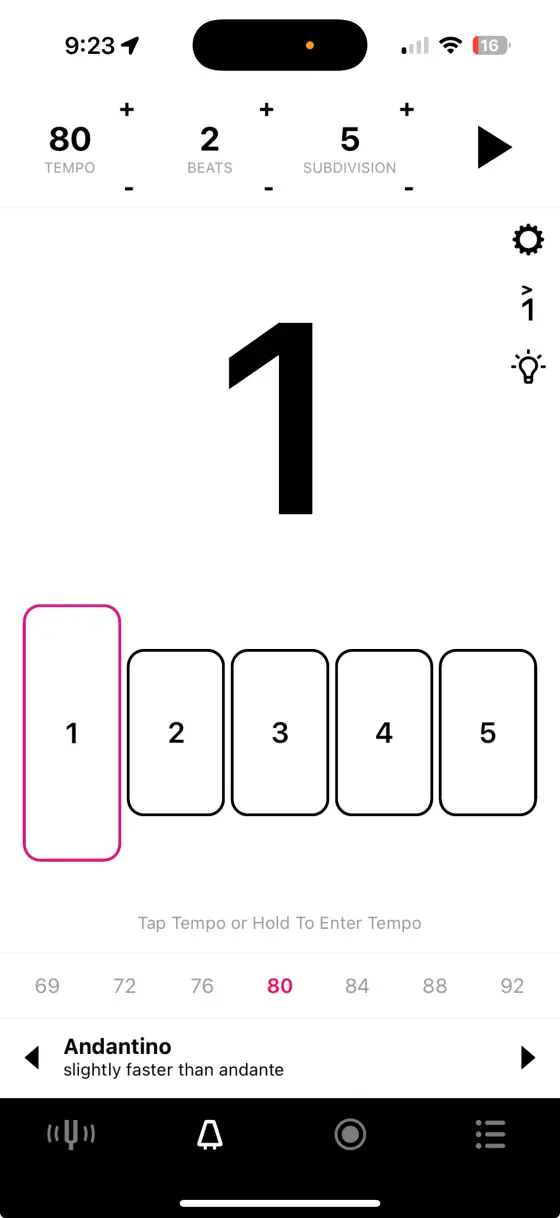
Start the metronome, switch to the tuner, and the click keeps going. Subdivisions, accents, 30+ sounds, and Ableton Link on iOS so a whole section's phones click together.
Pick your instrument and the tuner's note name matches your part: a Bb clarinet playing written C sees C, not Bb. Fifteen notation systems cover solfège and the German H.
Record, review, and share
Record unlimited practice sessions, play them back at half speed, add reverb, and send them to a teacher. Each recording keeps its pitch graph, so you can hear and see the same phrase.
Tunable by instrument
One app, one price, every instrument. Each family below links to the free browser tuner for that instrument, which uses the same pitch display, and to the reference page for its range, fingering or tuning.
Woodwinds
Woodwind pitch moves with breath support, embouchure and temperature, so a snapshot needle is the least useful kind of tuner. The pitch history line shows the whole note, including the sag at the end of a long phrase.
Flute tuner app
Concert pitch, so the note name is the note you read. Flute runs sharp when the air is fast and flat when it is slow; the history line shows which one is happening as the note develops, and Practice Score tells you how much of each long tone was inside the green zone.
Clarinet tuner app
Set the transposition to Bb and the display reads your written notes, not concert pitch. The throat tones and the altissimo register each have their own tendencies; a saved session per register makes them visible over a week of practice.
Free online clarinet tuner · Bb clarinet range and transposition
Saxophone tuner app
Eb presets for alto and baritone, Bb for tenor and soprano. Saxophone tuning is mostly about the mouthpiece position and then voicing each register; the app remembers your reference pitch and transposition so a band warm-up takes one tap.
Oboe and bassoon
Double reeds give the band its A and get blamed for everything after it. The adjustable Concert A and the tone generator let you check a reed against A440, A441 or A442 before the rehearsal starts.
Brass
Brass players tune a slide once and then play every note in tune with their ears and their lips. The app is for the second part: it shows the pitch of every partial you play, not only the tuning note.
Trumpet tuner app
A Trumpet preset reads in Bb, and the By Key transposition setting covers C, D, Eb and piccolo trumpet. The fifth partial runs flat and the sixth runs sharp on most horns; a session recording with the note graph shows exactly how much on yours, so you know where to kick the third slide.
French horn tuner app
The French Horn preset reads in F, and By Key transposition handles the Bb side or a part in Eb. Horn pitch depends on the right hand as much as the slides; the history line shows a hand position drifting long before your ear admits it.
Trombone and euphonium
Trombone is the one instrument where every note is a tuning decision. With the tuner and the metronome running at the same time, you can check slide positions at tempo rather than one long tone at a time. Baritone and Euphonium presets cover players reading Bb treble clef.
Tuba tuner app
Detection reaches the pedal register, which many tuners give up on. BBb, CC, Eb and F tuba are all read at concert pitch by default, and the tone generator can sustain a low drone to tune the section against.
Strings
Bowed strings tune four open strings and then produce every other pitch by ear. Plucked strings tune more often and want a fast, stable reading per string. The app handles both.
Violin, viola and cello tuner app
A tuning stays accurate for the whole bow stroke, so the reading does not jump when the bow changes direction. The just intonation and Pythagorean temperaments are there for players who want to check thirds and fifths against something other than a piano.
Guitar and bass tuner app
Chromatic tuning for standard, drop and open tunings without switching modes, with detection that holds the low B of a five-string bass. Reference tones from the tone generator let you tune by ear on a noisy stage.
Ukulele tuner app
Standard gCEA, low-G and baritone DGBE all read chromatically. New strings stretch for days; the saved history makes it obvious which string keeps slipping.
Voice, piano and harp
Not every tuner user has a slide or a peg to turn. Singers and keyboard players use the app to hear and see pitch rather than to adjust hardware.
Vocal tuner app
Singers see vibrato as a wave around the target rather than a needle flicking between two notes. The tone and chord generator sustains a pitch or a full chord to sing against, and recordings with the note graph show where a phrase went flat.
Piano and harp
A chromatic tuner reads one string at a time, so it is a check on a piano or a harp rather than a replacement for a technician. The harp pedal and lever settings do not matter to the tuner; it reads whatever pitch sounds.
Try it in the browser first
The free online tuner and free online metronome on this site are the app's pitch display and click running in a web page, with no download and no account. They are deliberately narrow: equal temperament only, no saved history, no recording, and they need a browser tab open. If the pitch history line is useful to you there, the app is the same idea with everything else attached, and it works offline.
Who uses Tunable
Tunable is used by students and faculty at the Juilliard School and Berklee College of Music, by musicians in Broadway pit orchestras, and by band and orchestra teachers who put it on a classroom iPad and mirror it to a screen with AirPlay so the whole section can see the same needle. It is developed by AffinityBlue, a small independent company, which is why it is a one-time purchase and not a subscription.
Frequently asked questions
Is the Tunable tuner app free?
No. Tunable is a one-time purchase, $7.99 on the App Store and $6.99 on Google Play, with no subscription and no ads. The online tuner and online metronome on this site are free to use in a browser if you want to try the pitch display first.
Which instruments does the tuner app work with?
Any instrument that can sustain a pitch: woodwinds, brass, bowed and plucked strings, piano, harp, and voice. Transposition presets cover Bb, Eb, F, A and other transposing instruments so the note name matches your written part, and the detection range runs from the lowest tuba and bass notes to piccolo.
What devices does Tunable run on?
iPhone and iPad on iOS 13 or later, Mac on macOS 11 or later, Apple Vision, and Android phones and tablets. One App Store purchase covers iPhone, iPad and Mac.
How is the app different from the free online tuner?
The web tuner is equal temperament only, keeps no history, and needs a browser and a network connection to load. The app works offline, remembers your settings, records sessions, scores how long you hold each note in tune, and adds 15+ temperaments, a metronome that keeps running while you tune, a tone and chord generator, and ear training.
Does the tuner app work offline?
Yes. Pitch detection runs on the device, so the tuner, metronome, tone generator and recorder all work with no signal, in a pit, a practice room or on a plane.
Can I change the reference pitch from A440?
Yes. Concert A is adjustable from 415 Hz to 466 Hz, which covers Baroque pitch at A415, the A441 to A444 used by many European orchestras, and anything in between. The app remembers your last setting.